  |
| |
Equipment
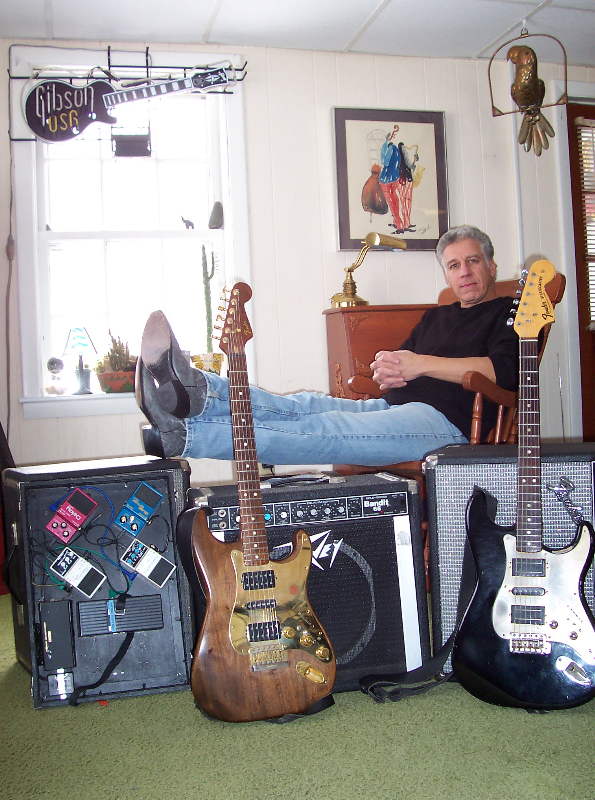
My equipment and sound has remained the same for
many years. My main guitar is a late sixties Fender Strat. It has two
Lawrence L-90 pickups, one in the neck and one in the bridge position.
The pickups are wired to two on-off toggle switches and straight to the
volume control and straight out. There is no tone control or filter in
this guitar. This guitar sounds big. The notes are thick like a
foghorn. My backup guitar is about a 1980 walnut Fender Strat. This too
is fitted with Lawrence L-90 pickups and wired the same way with no
tone control. The volume control on both guitars is always all the way
up, and I control my volume with a volume pedal. Both guitars use GHS
guitar strings. Set number 1315, .011-.050 gauge. But as long as
they re 11 s on top, I can usually get by with any brand. And I use
Fender heavy gauge teardrop guitar picks.
My main amplifier is a first generation Fender Stage Lead solid state
amp. This amp gives me plenty of honk. I also have a second Stage Lead
from around the same era that my amp guy, Vinnie Collins, rewired the
same as my main amp, since later editions of that amp had used
different components which altered the sound from the originals. I also
have a 1987 Peavey Bandit 65 amp that has been a solid sounding and
durable backup to the backup amp. My amp is set with the volume at 8,
the gain at 7, the master at 6, the treble in the range from 7 to 9,
the mid all the way up, the bass all the way up and the reverb set at
about 4.
My pedal board is fitted with four effects pedals, all by Boss. A BD-2
Blues Driver, a DD-3 Digital Delay, a DM-3 analog delay and a NS-2
Noise Suppressor/Power Supply. I also have a Seiko Tuner and a Korg
volume pedal. The analog delay is the only pedal that is always on,
just to fatten the sound. The other pedals are used only when needed.
For micing when recording, I use two Sure 57 microphones. One placed
facing the speaker at the speaker grill, and the other placed at the
speaker grill at a ninety degree angle to the first mic.
The guitars, the pickups, the amps, they all take care of business real
well to give me my sound. When I m all the way up the single notes are
thick. When I turn down the volume I can still get full sounding chords
without distorting. |
|
More Guitars
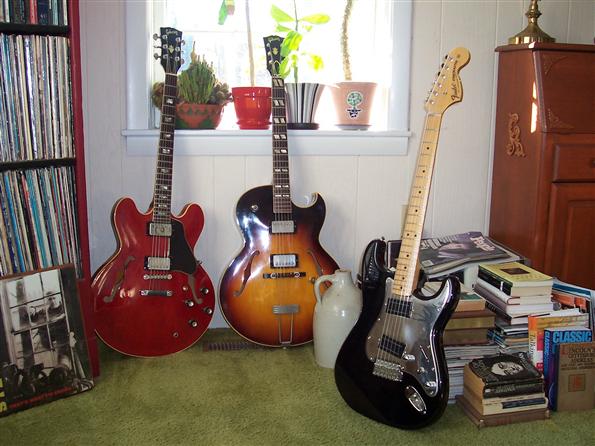
Three more guitars in my arsenal are a late 50 s Gibson
ES-175, an early 60 s Gibson ES-335 and a re-issue 1969 Fender
Stratocaster. The 175 gives me the warmth and full sound of traditional
Jazz. I traded a Walnut Les Paul in the 80 s for it. I ve used it for
everything from straight ahead Jazz in small ensemble gigs, to duos,
backing up instrumentalists and vocalists, to solo playing, everywhere
from soup kitchens and homeless shelters to the Trump Towers in NYC.
The 335 is the quintessential all around commercial workhorse, helping
me to work my way through college in everything from an Elvis
impersonator gig, to clubs, rock gigs, weddings and private functions.
Sold to me in the 70 s by my friend and fine musician, Steve Albrecht,
he told me that he wanted me to buy it because he believed I would play
great music on it, a great compliment. And also, if I should ever sell
it, I had to sell it back to him. I did my best to honor his first
wish. The second wish doesn t apply; I ll never sell the guitar.
The re-issue Strat has become my everyday guitar. I bought it to take
the wear and tare off my other Strats. My 1967 Strat has had three sets
of frets on it, and the finger board has become to worn for many more
frettings. And the walnut Strat has had two sets of frets. The re-issue
is customized, again, with Bill Lawrence L-90 pickups, one volume
control and one tone control, and a three way toggle pickup selector
switch.
|